

The Grand Tour in Four Parts – The White Horse Bookshop, Marlborough
Talk One – The Grand Tour Concept
Talk Two – Florence: Cradle of the Renaissance
Talk Three – Rome: The Eternal City
Talk Four – Venice: The Most Serene Republic
Talk One – The Grand Tour Concept
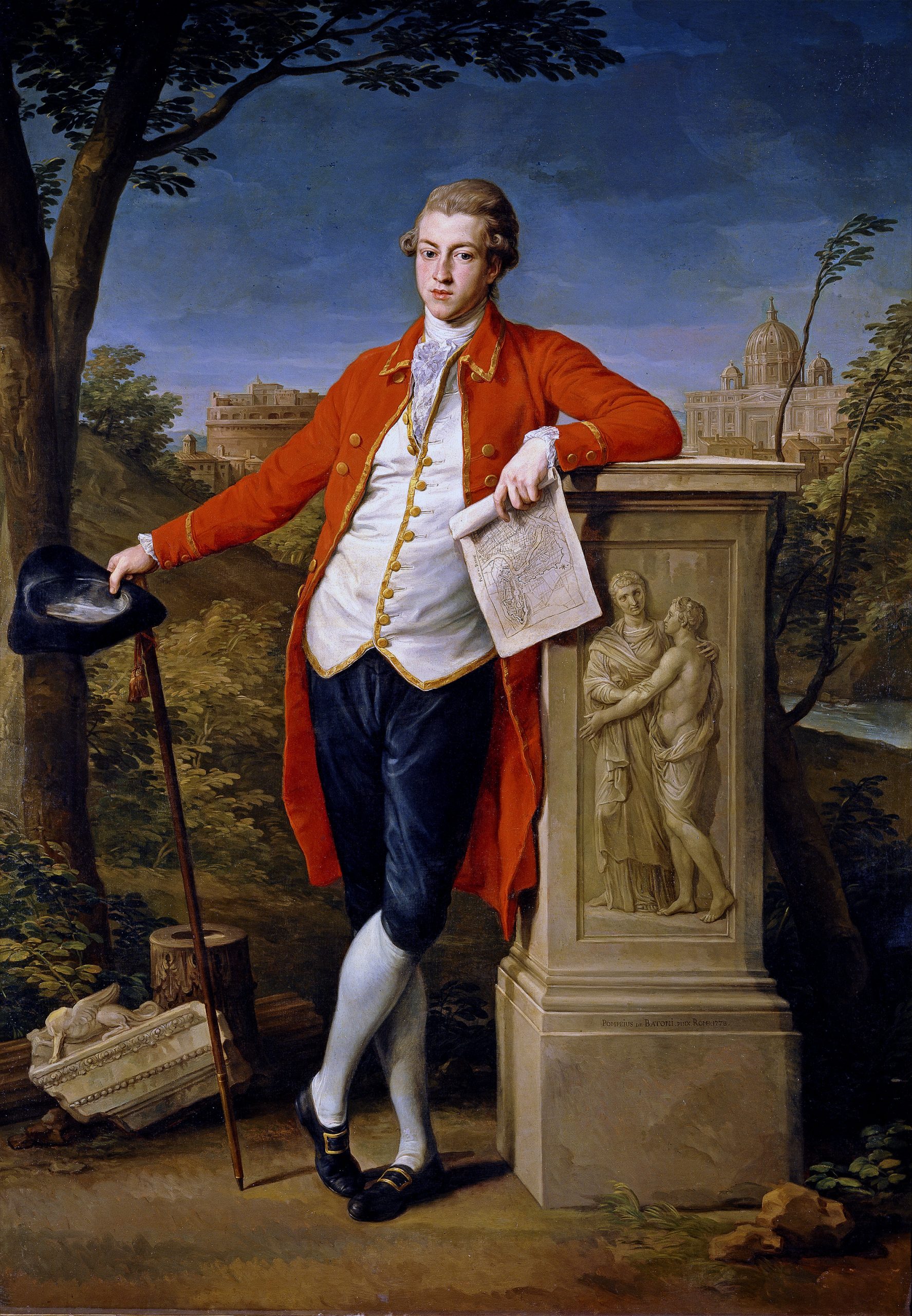
From the seventeenth to the early nineteenth century, the Grand Tour was deemed a rite of passage for 21-year-old upper class men known as Milordi; a cultural sojourn through Europe, with Italy as the key destination. Typically, the British nobility or landed gentry were in the hands of a guide or tutor (Ciceroni) known colloquially as ‘bear-leaders.’ Focussed on aristocratic andragogy, foreign travel of this ilk completed the post-university education of an English gentleman. As part of a programme of intellectual self-improvement, the Grand Tour included lessons in language, etiquette, courtly behaviour and fashion – even fencing lessons! As a peregrination, focus was placed on crumbling ruins, ancient sites, galleries and museums. Richard Lessels’ guidebook The Voyage of Italy of 1670 captured the four tropes of the ideal traveller: intellectual, social, ethical and political. Popular texts such as An Account of Some of the Statues, Bas-Reliefs, Drawings, and Pictures in Italy published in 1722 by Jonathan Richardson popularised such trips.
The Grand Tour waned due to the advent of rail and steamship travel, although it enjoyed a renaissance in America’s Gilded Age of the 1890s. The period following the Civil War was a time of rapid industrial expansion in the United States, during which the nouveau riche of both sexes embarked upon the Grand Tour. Whatever the case, Grand Tourists would return with crates full of books, works of art, scientific instruments, and cultural artefacts to be displayed in long galleries, libraries and cabinets as trappings of travel. The portraitist Batoni captured the elite traveller, and artists known as Vedutisti popularised nostalgic topographical vistas of Italy; most famously Canaletto, Pannini and Guardi. Renowned Grand Tourists who sought to document their personalised rite of passage included William Beckford, Lord Northwick and Lord Byron. More recently, Margaret Mitchell’s seminal novel Gone with the Wind and Sister Wendy Beckett’s televisual pilgrimage are further responses to the Grand Tour.
Talk Two – Florence: Cradle of the Renaissance
“If we are to call any age golden, it is beyond doubt that age which brings forth golden talents…..That such is true of this our age no one will doubt. For this century, like a golden age, has restored to light the liberal arts, which were almost extinct: grammar, poetry, rhetoric, painting, sculpture, architecture, music…. And all this in Florence.” (Leonardo da Vinci, 1492)
This was the Florence of Leonardo’s youth, a place of self-conscious innovation and creative energy. It was a city of “gold” – of great economic wealth – where a proto-democratic constitution allowed a new merchant class to become prosperous. As a result, Florence saw an unsurpassed artistic flourishing. The city became the nucleus of the early Renaissance in Italy, where the great “golden age” of Classical culture was reborn.
Building upon the foundations laid by Giotto di Bondone in the Trecento, the painter Masaccio, with his understanding of the laws of linear perspective, is the first true artist of the early Renaissance in Florence. Within the climate of Humanism and erudition, man was the measure of all things, to quote Protagoras. Masaccio, alongside the sculptor Donatello and the architect Brunelleschi, are hailed as the trinity of genius of the Florentine Quattrocento. Florence was a Republic, and political power resided in the hands of middle-class merchants, a few wealthy families such as the Medici and the powerful guilds. Patronage was key, partly through the system of Guilds, leading to the creation of some of the most significant works of the cultural flowering of the Renaissance, by Ghiberti, Botticelli and Michelangelo, to name but a few.
Talk Three – Rome: The Eternal City
‘Upon entering the Vatican Museums and visiting the rooms painted by Raphael and the Sistine Chapel, one encounters perhaps the supreme expression of Italian Renaissance art.’ (John Marciari, Art of Renaissance Rome: Artists and Patrons in the Eternal City).
Pilgrimage flourished in Rome during the Renaissance when Popes declared Holy Years, during which those who came were granted a full pardon for their sins. This led to an element of urban renewal funded by money from pilgrim footfall. Emphasis was placed on the centrality of the church and sacred concerns, with Rome set as Caput Mundi, or capital of the world, with the Papacy and cardinals at the core. The Catalyst for the High Renaissance in Rome during the Cinquecento was the rediscovery of ancient works such as the Apollo Belvedere, the Belvedere Torso and Laocoon, which led to an all’antica approach. Painters flocked from Florence, Perugia and Urbino to Rome, and a Golden Age existed under Pope Julius 11 and Leo X, the greatest of the artistic patrons of this era. Another trinity of genius in Michelangelo, Bramante and Raphael existed, spurred on by collections of newly unearthed antique remains, and Rome became a school for sculptors and painters using classical or antique paradigms.
Furthermore, Rome is said to be where the most supreme expression of Italian Renaissance Art took place – the ultimate distillation of ideas and a synthesis of blended idealism and realism across all the disciplines of painting, sculpture and architecture. Giorgio Vasari identifies this period as the summit of perfection which shows an understanding of rule, a better knowledge of order, correct proportion, perfect design and inspired grace.
Talk Four – Venice: The Most Serene Republic
Dubbed ‘but another world’ by the great Humanist scholar Francesco Petrarch, Venice is the Queen of the Adriatic and the centre of another wave of late Renaissance art during the late Quattrocento and early Cinquecento. Given her position as a trading port between Europe and the East, Venice flourished in mercantile terms to become a cosmopolitan state governed by the Doge or chief magistrate. A major confluence for the trade of silks, spices, precious metals, dyes, pigments and materials, Venice grew to become a very wealthy city, synonymous with its exotic, colourful and vibrant art, best embodied by the painterly works of Bellini and Titian or the architecture of Bon’s Ca d’Oro. The enigmatic atmosphere in Venetic art also stems from its Byzantine heritage; that of strong colour, rich surfaces and a jewel-like intensity in decorative terms. Coined by the Venetians themselves as ‘La Serenissima’, or the most serene republic, Venice’s unique clarity of light made it a mecca for artists and patrons in the 16th century and, of course, beyond.
However, one may detect a more maudlin and introspective tenor in paintings by Giorgione and his contemporaries, for, beginning in the early 15th century, the island of Lazzaretto Vecchio was designated for isolating and treating plague-stricken Venetians. In fact, the English word ‘quarantine’ is based on the Italian term for 40 days, quaranta giorni, the period of exile. The church of Santa Maria della Salute on the Grand Canal was built as a votive offering in response to the second major bout of The Plague in Italy in the 17th century. This more melancholic element to Venetian art sits in marked contrast to the proto-Mannerist works of Veronese and Tintoretto renowned for their flagrant disregard of the rules of Classicism in favour of unbridled colorito and distorted perspectives.
To book tickets for any of the lectures please go to https://www.whitehorsebooks.co.uk/ and search for Summer School 2026